
Humane Solutions does beaver management in Alberta. We deploy specialists into the province for complex, high-liability flooding, culvert and drainage work. They travel from our operating base just south of Revelstoke, BC, so we don't keep a local Alberta crew. We generally aim to start with whether the dam is active and which provincial rules apply, and to finish with a plan for holding the water at a level the site can live with.
What does Humane Solutions do for beaver problems in Alberta?
We handle beaver flooding of roads, fields, drainage and private property for municipalities, First Nations, agricultural operators, airports, utilities and conservation groups. The work centres on the water: where it is rising, what it is backing up into, and what it will take to hold it at a level the property can tolerate. That usually means flow control at the dam or the culvert, then monitoring, instead of treating the dam as the whole problem.
Who can act on a beaver dam in Alberta?
That depends on who owns the land, who is doing the work, and whether a lodge is involved. The Government of Alberta says beavers may be hunted and trapped without a licence and during all seasons on privately owned land by the owner or occupant, or by a resident with written permission from the owner or occupant (Government of Alberta, Human-wildlife conflict – Beavers). Beyond that provision, beavers may be trapped under a Fur Management Licence during an open trapping season, or by someone holding a Damage Control Licence, which authorizes removal outside normal trapping seasons (Government of Alberta, Human-wildlife conflict – Beavers).
Dams are treated separately. Disturbing or removing a dam with a lodge nearby, or a den or lodge itself, without a Damage Control Licence is against the law on both private property and Crown land. In some cases, federal approval may be required to breach or remove a lodge or dam (Government of Alberta, Human-wildlife conflict – Beavers).
| Situation | What the Alberta rules say | What we check first |
|---|---|---|
| Owner or occupant of privately owned land | Beavers may be hunted and trapped without a licence, in all seasons | Whether a lodge or den is nearby |
| Resident with written permission from the owner or occupant | The same private land provision applies | Written permission on file |
| Trapping outside the private land provision | Fur Management Licence in an open season, or a Damage Control Licence, which authorizes removal outside normal trapping seasons | Licence status before any work starts |
| Dam with a lodge nearby, or a den or lodge, on private or Crown land | Disturbing or removing it without a Damage Control Licence is against the law | Whether a lodge sits near the dam |
| Breaching or removing a lodge or dam | Federal approval may be required in some cases | Jurisdiction and approvals |
The table is a starting point, not legal advice. Anyone planning dam work should confirm current requirements with an Alberta Fish and Wildlife office before acting.
How do you tell whether a beaver dam is active?
Our method is a test notch. We open a small notch in the dam, about as wide as a boot and about 2 inches deep, just enough for the water to start making noise through it, and check it the next morning. If beavers have repaired it overnight, the dam is active and the colony is working against any level you want to hold.
Before any notch, look for the general signs of a working dam:
- Fresh mud packed on the upstream face
- Peeled sticks or freshly cut stems worked into the top
- Water held right up to the crest, with little seepage through gaps
- New cuttings or drag trails along the nearby banks
Breaching or otherwise altering a dam can need provincial authorization. In Alberta, that means the rules above and the Fish and Wildlife office. Our BC dam rules page covers British Columbia only.
Why does removing beavers rarely fix flooding?
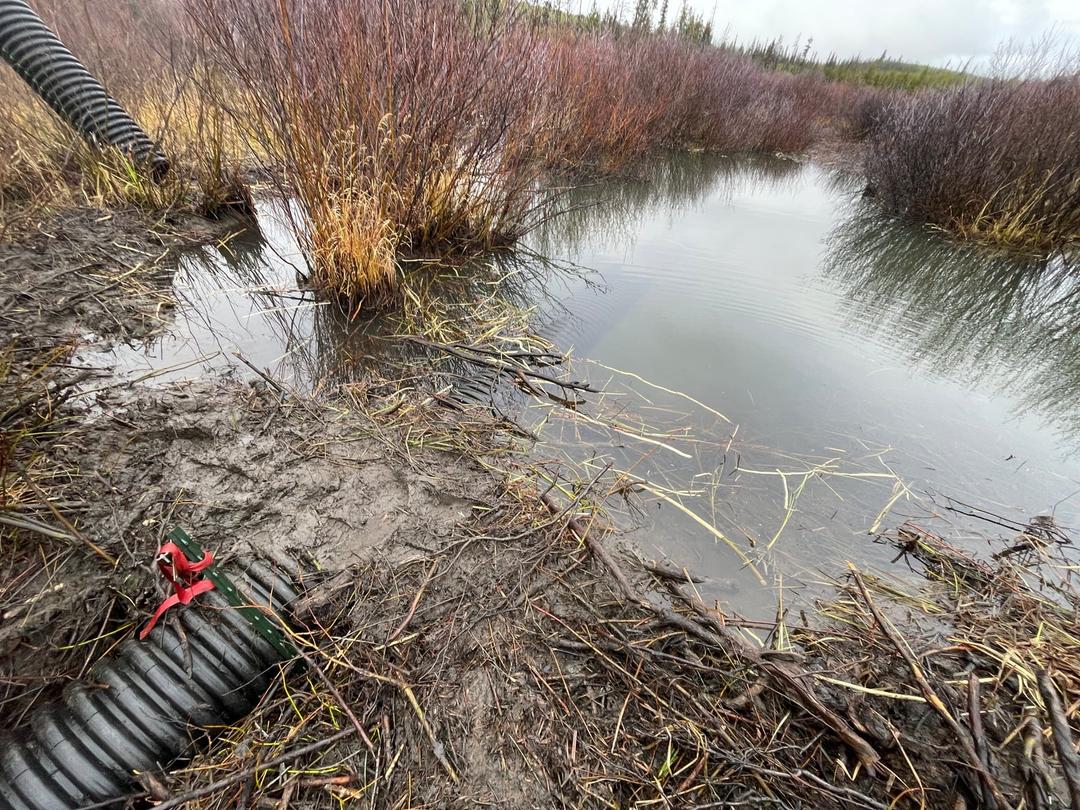
The flooding comes from the water level, and the water level is set by what sits at the outlet. While beavers remain on a site, a breached or removed dam is often rebuilt. A drained pond with good habitat around it can draw beavers back. Parks Canada's approach at Elk Island National Park is a useful model. At sites where beaver activities do threaten infrastructure, water levels are managed so they are adequate for beaver colonies and other aquatic organisms, but low enough to prevent damage to infrastructure. In most cases this is done by opening plugged culverts, putting small breaches in dams, and installing water-flow devices that beavers have difficulty blocking (Parks Canada, Beaver management – Elk Island National Park (2022)). The park also notes that most of its beaver ponds pose no threat to infrastructure and need no active management. Not every pond is a problem.
How are culverts and water levels held in place?
A culvert is the easiest place for beavers to raise water, because the opening already concentrates flow and sound. A blocked crossing can overtop a road before anyone notices. We do not install beaver deceivers. Stock deceivers are often undersized for spring runoff, they are easy for beavers and debris to block, and they need regular clearing.
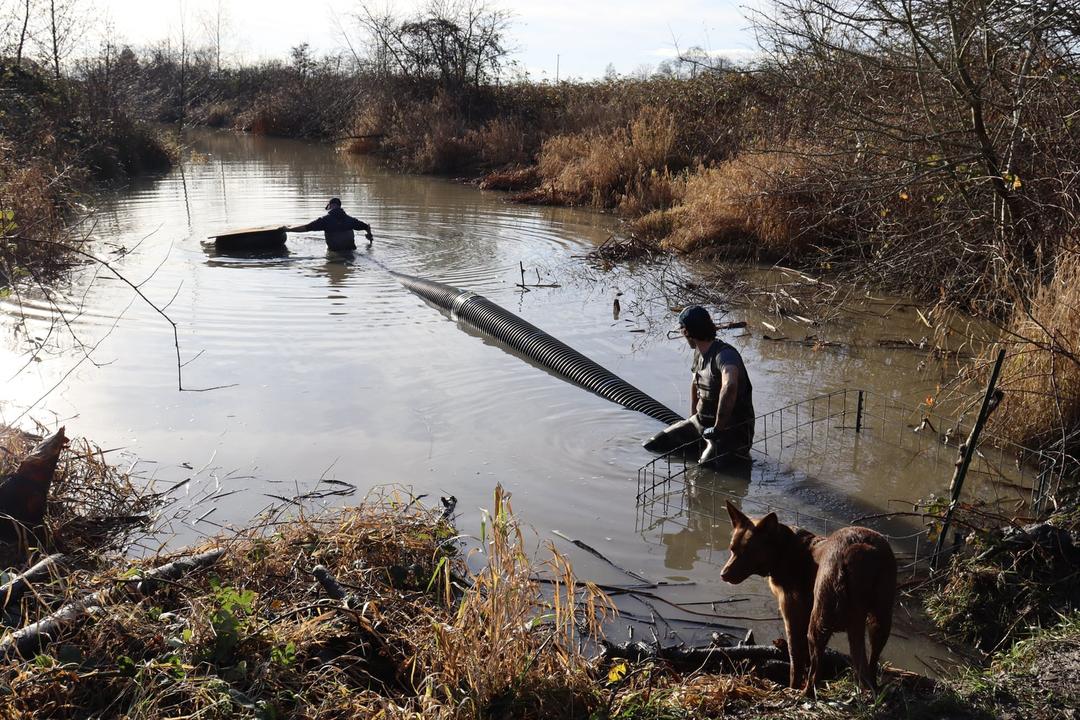
At culverts we use a combo device: an exclusion fence with a pond leveler through it, sized to each crossing. Where a leveler needs to be fitted directly to a culvert, we use an installation method we developed for this work, and we guarantee it against beaver interference. More detail is on our pond levelers and flow-control devices page.
For an example of the same flow-control work in BC, our Clapperton Creek project in the Nicola watershed involved pond levelers in three beaver dams.
How should a municipality choose a beaver contractor in Alberta?
Look for a firm that asks about the water before it talks about the animals. A good first conversation covers the drainage path, the infrastructure at risk, the season and the permit position. It should end with a plan for the water level you need to hold. Reactive removal on its own leaves the dam site and the habitat that drew beavers there. A coexistence plan, built on flow control and follow-up monitoring, gives a more predictable result. For dam work on the BC side of the border, see our BC dam removal rules page.
FAQ
Sources
- Government of Alberta, Human-wildlife conflict – Beavers (no year given): https://www.alberta.ca/beavers
- Parks Canada, Beaver management – Elk Island National Park (2022): https://parks.canada.ca/pn-np/ab/elkisland/nature/conservation/faune-wildlife/castors_beavers2
Common questions
Does Humane Solutions have a crew based in Alberta?
No. Our operating base is just south of Revelstoke, BC, and we deploy specialists into Alberta where they're needed. We're brought in for complex, high-profile and high-liability jobs that need a guaranteed professional result.
Can a landowner deal with beavers on their own property in Alberta?
Partly. The owner or occupant of privately owned land, or a resident with their written permission, may hunt and trap beavers without a licence in all seasons. Dams are a separate matter: disturbing or removing a dam with a lodge nearby, or a den or lodge, without a Damage Control Licence is against the law on private property and Crown land alike.
Do I need a permit to breach a beaver dam in Alberta?
It can be required. A Damage Control Licence is needed to disturb or remove a dam with a lodge nearby, and in some cases federal approval may be required to breach or remove a lodge or dam. Confirm the current requirements with an Alberta Fish and Wildlife office before making any notch or opening.
What is a test notch and why is it used?
It's our method for checking whether a dam is active: a small opening about as wide as a boot and about 2 inches deep, just enough for the water to make noise. We check it the next morning, and overnight repair means the colony is still working the dam. Breaching or altering a dam can need provincial authorization, so check the rules before making one.
Why not just remove the dam and be done with it?
While beavers remain on the site, a removed dam is often rebuilt, and the water level is what causes the damage. Holding a workable level with flow control at the outlet, then monitoring it, deals with that directly.