
Beaver dams that hold steady all winter can overtop or fail once the BC freshet arrives in May and June, when snowmelt pushes far more water through a pond than it held in January. The answer is to plan before the melt: confirm which dams are active, and size any pond leveler or culvert device for peak spring flow rather than summer baseflow.
Why do beaver dams flood during spring runoff?
They flood because the volume of water arriving changes faster than the dam does. A dam built and maintained through a low-flow fall and winter is shaped for that water. When the snowpack melts, the same structure has to pass, store or spill a much larger flow, and the pond rises until water goes over the crest, around the ends or through a weak point.
BC's own flood records describe the classic setup for spring runoff flooding: a winter with an above-normal snowpack, a cold and late spring, then a sudden warm spell in May, made worse by above-normal precipitation (BC Ministry of Environment, Flooding and Landslide Events Southern British Columbia). The same document notes that high water from this kind of flooding can last for weeks, and that failing beaver dams can cause considerable flooding damage on their own.
Research from the Alberta Rockies points the same way. In a Kananaskis study, all but one instrumented beaver pond reached its maximum impoundment during the spring freshet in late June (University of Saskatchewan, Dam different!, 2021). That is the window when a pond is fullest and a road, culvert or field below it has the least margin.
How does Columbia Mountains snowpack change the risk?
In the Columbia Mountains, around Revelstoke and the surrounding valleys, a deep snowpack means the freshet tends to be long and heavy rather than a short pulse. A dam that looked stable on a February inspection is being tested by a very different flow by late May. For property owners and road crews in that area, our beaver dam flooding work around Revelstoke starts with this seasonal timing, because a fix that suits August water may not survive June.
We deploy specialists to each site, so the useful time to call is before the melt, when there is still room to assess dams and install or adjust devices. Our beaver control work across the BC Interior follows the same principle.
Do beaver dams make freshet flooding worse or better?
Both, depending on the dam and the event. Intact beaver dams can slow runoff and reduce flood peaks. One study of a small stream with thirteen dams found a 30% reduction in peak discharge and a 29% increase in lag time, and in the Kananaskis work every instrumented dam reduced rainfall-driven peaks compared with nearby open stream (University of Saskatchewan, 2021).
The risk comes from failure. The same review notes that high flows can cause rapid dam breaches, that large rain events can raise the chance of failure and potentially increase flood size, and that partially breached dams may trigger overbank flooding at peak streamflow. So the question for a road or property owner isn't whether beavers are good or bad for floods. It's whether a specific dam, above specific infrastructure, can carry this year's freshet.
| Option before freshet | What it does in high water | Main limit |
|---|---|---|
| Monitoring only | Flags rising ponds and new dams early | Doesn't change water level |
| Pond leveler | Holds the pond at a set lower level, adds outflow | Pipe capacity must match freshet flow |
| Culvert protection | Keeps the crossing open as flows rise | Needs inspection after debris-heavy runoff |
| Breaching or removing a dam | Releases stored water | Can need authorization, may increase flow downstream, beavers often rebuild |
How can you tell if a dam is active before freshet?
Our method is a small test notch. We cut a notch about as wide as a boot and about 2 inches deep in the dam crest, just enough for the water to make noise, then check the next morning. If the notch has been repaired overnight, the dam is active and beavers are maintaining it. If it is still open, the dam may be abandoned and will be left to the freshet with no one patching it.
That distinction matters in spring. An active dam will be repaired as it erodes, but its owners will also keep raising it. An abandoned dam won't be repaired at all and can let go during peak flow. Breaching, removing or otherwise altering a beaver dam can need provincial authorization, so check the rules for notching or removing a beaver dam in BC before touching one.
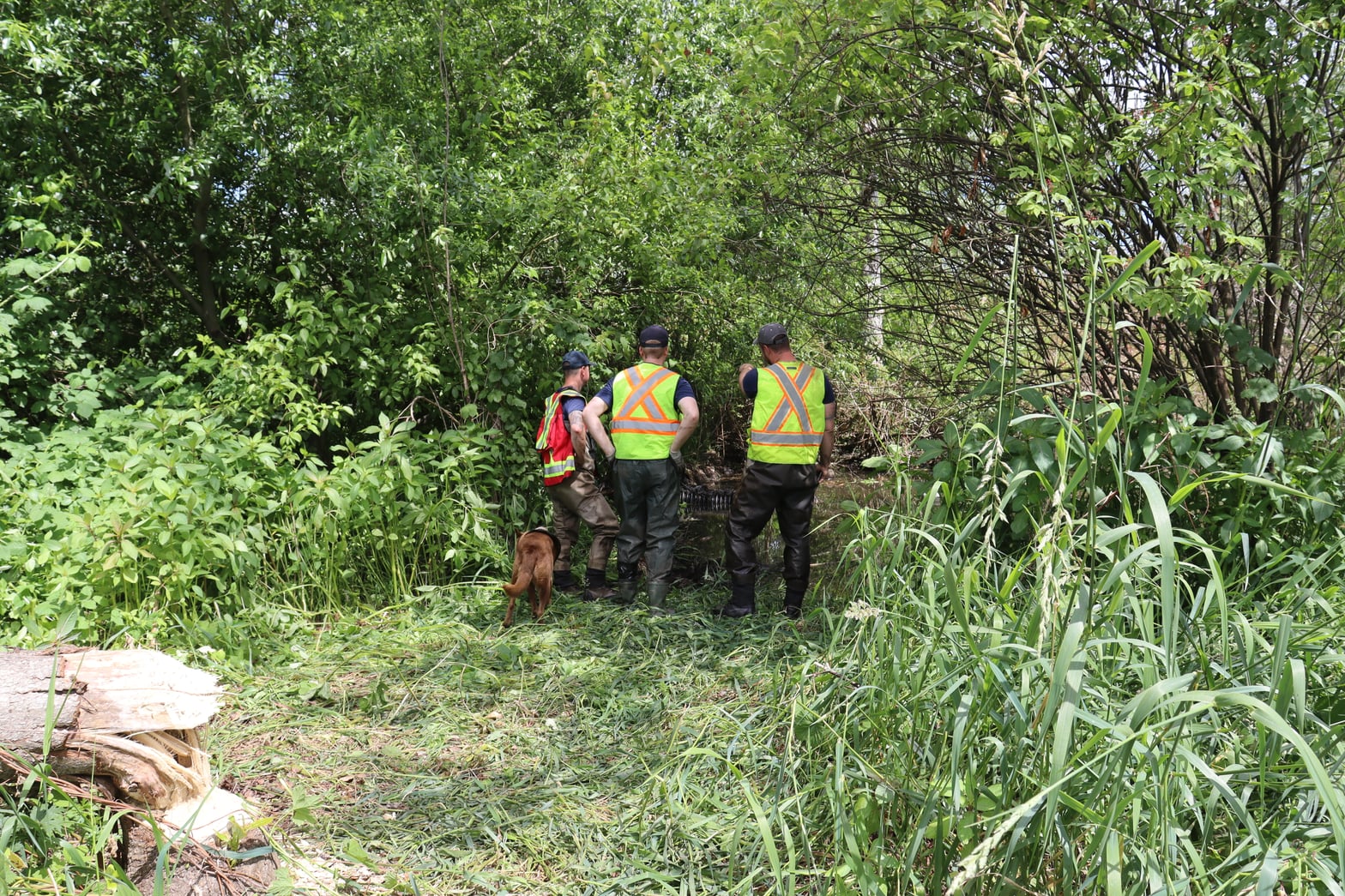
Other signs worth checking in late winter and early spring:
- Fresh mud and peeled sticks on the dam crest
- New cuttings on shoreline trees and shrubs
- A pond level that sits at or above the crest
- Water seeping around the dam ends rather than through it
- Debris already collecting at a downstream culvert inlet
How should pond levelers be sized for freshet flows?
Size them for the spring peak, not the season you install them in. A pond leveler sets the water level with a pipe through the dam, and that pipe has a fixed capacity. When freshet inflow exceeds what the pipe can carry, the pond rises and water goes over the dam regardless of the device. A leveler sized only for late-summer flow does its job for most of the year and then is simply outrun in June.
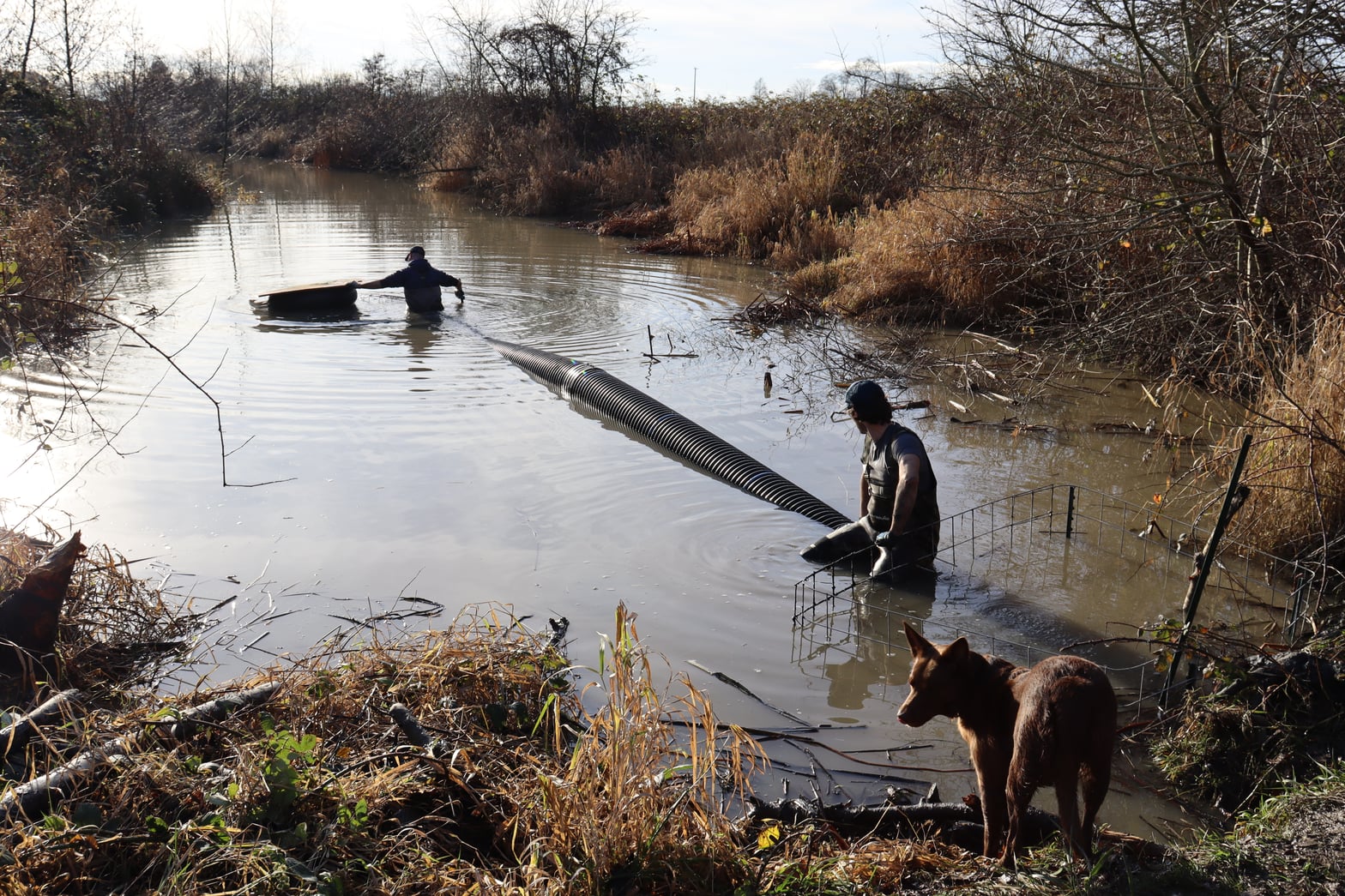
General sizing considerations for pond levelers and flow-control devices in snowmelt country include:
- The catchment above the dam and how much snow it holds
- The set level, so the pond has storage room before it reaches the crest
- Pipe diameter and whether one pipe or more is needed
- The intake fence, so it isn't buried in debris during runoff
- Access for a post-freshet inspection
On our Clapperton Creek project in the Nicola watershed, we installed pond levelers in three beaver dams, an approach built around keeping beaver ponds in place for the water they store rather than removing them (see the Clapperton Creek project). We have also put forward a proposal for beaver reintroduction in the Okanagan. Both reflect the same view: in dry Interior valleys, a well-managed beaver pond is often worth more to a watershed than an empty channel.
Should you breach or remove a dam before freshet?
Usually not as a first move. Breaching a dam releases its stored water, and BC records include a case near Chilliwack where breaking up a beaver dam across Luckakuck Creek increased the creek's flow and deepened it (BC Ministry of Environment). Doing that just ahead of the melt adds water to a system that is about to be at its fullest.
Removal also isn't permanent. The province's dam decommissioning guidance notes that beavers damming an excavated breach is a relatively common issue in BC, and that a blocked breach letting a reservoir refill can create a safety concern and liability for the owner. It recommends monitoring for one to five years, with the first freshet after removal as the best time to assess a site (BC Dam Decommissioning Guidelines, 2019). That guidance is written for engineered dams, but the lesson carries over: if beavers are in the drainage, the site needs a plan for next spring too.
Sources
- University of Saskatchewan, Dam different! How the physical properties of beaver dams influence ... (2021): harvest.usask.ca
- BC Ministry of Environment, Flooding and Landslide Events Southern British Columbia: env.gov.bc.ca
- Government of British Columbia, Dam Decommissioning Guidelines (2019): gov.bc.ca
Common questions
When is the best time to install a pond leveler in the BC Interior?
The low-water period after freshet, from late summer into fall, is usually the most practical window. Water is lower, the dam is easier to work on, and the device has months to settle before the next melt. Installing in spring means working against rising water.
Do you work on beaver dams around Revelstoke?
Yes. We deploy specialists to sites around Revelstoke and across BC, Alberta, Saskatchewan and Yukon as the work requires. For freshet-related beaver problems, calling before the melt gives us time to assess and plan the work.
What determines the scope of freshet beaver work?
Scope depends on how many dams are involved, what infrastructure sits below them, site access and the size of the catchment feeding the pond. Whether provincial authorization is needed and how much follow-up monitoring the site requires also shape the work.
Will a pond leveler stop all flooding during freshet?
Not on its own. A leveler holds the pond lower and adds a steady outflow, but a very large melt can still exceed the pipe's capacity. Sizing for peak flow and leaving storage room below the dam crest is what gives it the best chance.
Should culverts be checked before spring runoff?
Yes. A culvert partly blocked by beaver material or winter debris has less capacity just as flows climb. Inspecting and protecting crossings before the melt is far easier than clearing them at peak water.