
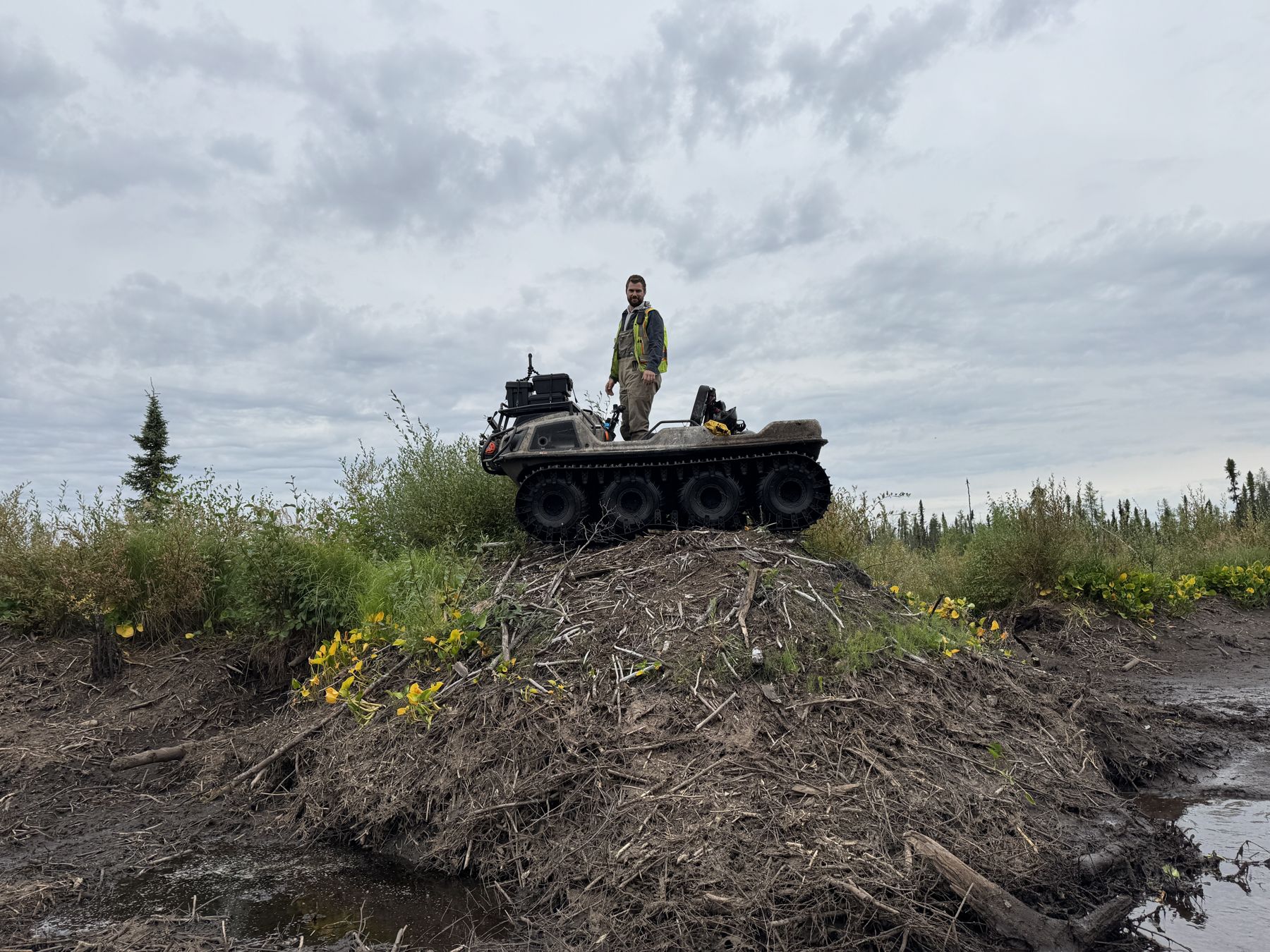
Beaver dams in muskeg, bog or deep wetland are removed by hand and with winch systems, by a crew that reaches the site on foot or in a tracked amphibious vehicle. Each dam is opened in stages down to the original streambed, working from the downstream end, while the crew watches the water below for sediment. It is slower to set up than a machine job, but it is often the only method that works, and it is the method regulators prefer.
Why can't you just use an excavator?
Because the ground won't hold one. Muskeg is a deep layer of saturated peat over a weak base, and beaver ponds make it wetter still. A tracked excavator that walks out onto it can sink to the cab, and getting it back out can cost more than the whole dam job.
Even where a machine can reach the bank, regulators lean the other way. Saskatchewan's Water Security Agency tells landowners to "remove beaver dams by hand whenever possible" (Water Security Agency). The federal Code of Practice says machinery should be operated "on land, from barges or on ice" (Fisheries and Oceans Canada), not driven through the creek.
How do you get a crew and gear to the dams?
On the remote jobs we take on, access is half the plan. We use a tracked amphibious Argo that floats across open water and crawls over muskeg, with a tub trailer for tools, winches and monitoring gear. Where even the Argo can't go, the last stretch is on foot.
On a recent job at a mine site in far northern Saskatchewan, the creek ran about a kilometre through muskeg that no machine could cross. The crew and the Argo made the trip from Vancouver, eight days of travel, and worked the entire drainage by hand and winch. You can read the full project story here.
How is a beaver dam taken apart by hand?
A beaver dam is packed sticks, mud and stones, woven tight and often decades old at the base. Pulling it apart is heavy work, and the order matters more than the muscle.
- Start with a small notch. The crew opens a narrow gap at the top of the dam to start a controlled flow. The federal Code of Practice calls for removing the dam "gradually, beginning with a small breach," and working in stages to control flows (Fisheries and Oceans Canada).
- Widen it as the pond drops. As water comes down behind the dam, the opening is cut deeper and wider, but never wider than the creek's original channel (Fisheries and Oceans Canada).
- Use winches for the heavy sections. Large woven logs and matted bases come out on winch lines anchored on firm ground. A winch lets two people move material that would otherwise take a machine, without anyone standing in the main flow.
- Finish at the old streambed. The dam is taken down to the original stream bottom so the creek runs as a single channel again. Debris left on the banks can be cleared later, once the ground has drained and firmed up.
Why do more dams show up as the water goes down?
Because beavers build in layers. Older dams downstream get flooded by newer ponds above them and disappear under the water. A drone survey or an aerial map only shows the dams that are above the surface on the day it was taken.
On the northern Saskatchewan job, the client's survey listed 19 dams. Every time a pond dropped, it uncovered more dams that had been sitting underwater further down, and the crew walked the full creek every day to pull them as they appeared. The final count was over 20. Any quote that treats the mapped number as the final number is a guess.
Which dam do you remove first?
Start downstream and work up. Saskatchewan's guidance is direct: "When more than one dam must be removed, start at the downstream dam and remove dams in an upstream direction" (Water Security Agency). Pulling an upstream dam first can send a surge into the ponds below and overtop or blow out the lower dams uncontrolled.
There is a practical exception. Where a client's main concern is water sitting on one area, such as a work pad, the crew may open the dams holding that water early, but only at a rate the dams and channel below can take. That call needs live information on what the water is doing downstream, which is where turbidity monitoring comes in.
What about the beavers?
Removing a dam without dealing with the beavers that built it is wasted work: active beavers start rebuilding overnight. Checking whether a dam gets repaired overnight shows whether it is still active before anyone commits to pulling the whole system. Our beaver dam flooding page covers how to read the signs.
The right approach depends on the site and the province. On sites where water must stay off the ground permanently, the long-term plan also includes checking for source lodges nearby that could send new beavers in. See beaver removal and relocation for how we approach that side.
How do you make sure a remote job finishes on time?
Remote dam removal fails in predictable ways: the survey undercounts the dams, the muskeg holds more water than expected, and the crew runs out of days. Planning around those risks is most of the job.
- Survey from the air first. Fly the whole drainage before anyone steps in the water, and plan for more dams than you can see.
- Bring everything. On a site days from the nearest hardware store, spare winch line, anchors and parts are part of the schedule.
- Price and schedule for the unknowns. We take remote dam jobs on a fixed scope with a set completion date, so the client isn't carrying the risk if the dam or beaver count climbs.
- Monitor the water the whole time. Real-time readings let the crew release water as fast as the creek can safely take it, rather than guessing slow and adding days on site.
If you manage a mine, pipeline, utility corridor or road with beaver dams in ground machines can't reach, we deploy specialist crews across British Columbia, Alberta, Saskatchewan and Yukon. See beaver management in Saskatchewan or contact us about your site.
Sources
- Beaver dam removal, Water Security Agency (Saskatchewan)
- Code of practice: Beaver dam breaching and removal, Fisheries and Oceans Canada