
Beavers don't pick a spot in the middle of a pond and start piling sticks. They burrow a bank den into a high, stable bank of a creek or pond, then build their dam. As the water rises and rolls over the banks, they pile material onto that den to raise it and dig it out from the inside. The lodge grows as the pond forms around it.
Where does a beaver lodge actually start?
It starts as a burrow in the bank. In our work, beavers always dig into the bank first and begin with a simple bank den. That den is often invisible from above ground for weeks, sometimes months, while the beavers get the things that matter most underway, starting with the dam.
Most people picture the finished product: a dome of sticks and mud sitting out in open water. That picture isn't wrong about the end result. University extension material describes lodges as dome-shaped structures of sticks and mud with a large interior chamber above the water line (University of Kentucky Forestry and Natural Resources), and the Smithsonian notes that lodges are often built away from the shore, forming islands that can only be entered from underwater (Smithsonian's National Zoo). What the picture leaves out is how the lodge got there.
The beavers move into a single-threaded creek or a small pond. They look for a high, stable bank and burrow into it. Bank dens are a normal part of how beavers live, and in some places beavers dig burrows into the banks of ponds, rivers and drainage ditches instead of building a lodge at all (University of Kentucky Forestry and Natural Resources).
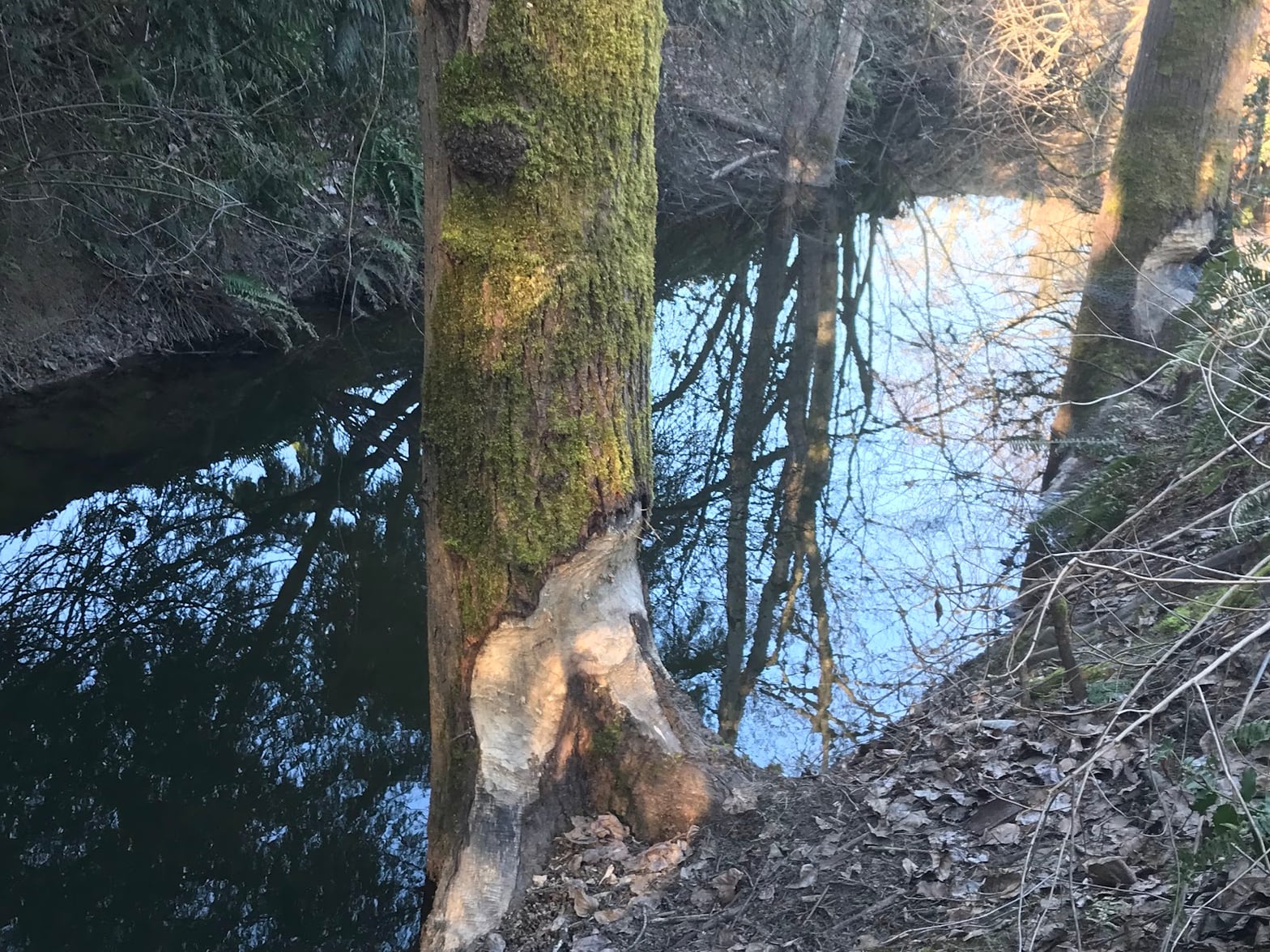
How does a bank den turn into a lodge?
The dam does the work. Once the dam raises the water above the original creek bed, the water starts to roll over onto the banks. As the level climbs, the beavers pile material onto the bank den to raise it, and they excavate it from the inside out to keep the living space above the water.
The pond forms gradually from the creek, and the beavers add mass and height to the lodge in proportion to that rise, shaping it from the inside as they go. By the time a lodge looks like an island, it has usually been through every stage below.
| Stage | What the beavers are doing | What you see from shore |
|---|---|---|
| Arrival | Burrowing a den into a high, stable bank of a creek or small pond | Little or nothing, sometimes for weeks or months |
| Dam building | Raising the water above the original creek bed | A new or growing dam, water starting to spread |
| Water on the banks | Piling material onto the bank den and digging it out from inside | A mound of sticks and mud forming at the bank edge |
| Established pond | Adding height and mass as the water keeps rising | A lodge that appears to sit out in the pond |
Underneath all of this, the entrances stay underwater. Lodge and bank den entrances, normally two or more, are located below the water line (University of Kentucky Forestry and Natural Resources).
Why does the lodge end up surrounded by water?
Because the pond came to the lodge, not the other way round. The den was dug into dry bank above a creek. The dam then flooded that bank, and the beavers kept building upward to stay ahead of the water. What looks like a deliberate choice of an open-water site is really an old bank that has gone under.
This is also why lodges vary so much. Clemson Extension describes island lodges, bank lodges and stick lodges depending on the body of water, each with sleeping chambers connected to the entrance by tunnels (Clemson Cooperative Extension). A lodge that still hugs the shoreline and one that stands well out in a pond can share the same origin. The difference is how much the water has risen around them.
What does draining a beaver pond reveal?
The original creek. Every beaver pond is a flooded creek, and the original channel is still there under the water. If the dam is completely removed and all the water drains out, that channel becomes visible again, along with the banks the beavers first dug into.
Draining also exposes the lodges, and that changes what can be done next. On one of our jobs, a worker dug up a beaver flow-control device, reburied it deeper in the dam and drained the pond. That exposed the lodges and made pole-set trapping impossible, so only Conibear-type body-grip traps would work. Lowering water is never just a drainage decision. It reshapes the whole site the beavers built.
Where should you look for an early bank den?
Look at the banks, not the open water. A newly arrived beaver will be in a high, stable bank of the creek or pond, and the den may not show from above ground at all while the dam is going up. Useful things to check:
- High, firm sections of bank along a single-threaded creek or small pond
- Fresh chewing on nearby trees and saplings
- A new dam, or a rise in water over the original creek bed
- Sticks and mud starting to pile up at the water's edge
- Movement between nearby wetlands, including through road culverts
Bank burrowing doesn't stay confined to natural creek banks. On one lakefront job, beavers were tunneling beneath a dock and creating a collapse hazard. Fencing, buried mesh barriers or a pond leveler were options there, depending on site conditions. On another lakeside property, beavers were tunneling throughout the property in winter.
In our call records, beaver calls peak in April, May, August and October. Spring and late summer are good times for landowners and municipal crews to walk their banks with this in mind.
How this shapes our approach to beaver management
Knowing that a lodge starts as a hidden den changes how we read a site. A pond with no visible lodge may still have beavers in the bank. A dam that looks abandoned may not be. On one site, new beaver activity found during an inspection affected whether the dam could be removed. Elsewhere, we found no active beaver presence on a property but light activity in the surrounding areas, and recommended monitoring with a follow-up at the start of the next beaver season.
Beavers are ecosystem engineers, recognized for their ability to build dams and create ponds (Parks Canada). Working with that, rather than against it, usually means mapping dams, lodges and drainage infrastructure before choosing between flow-control devices, dam work or removal and relocation. If rising water is already reaching roads or property, our beaver dam flooding page explains how we assess it, and you can contact our team to talk through a site.
Sources
- Clemson Cooperative Extension, Beaver General Info: https://www.clemson.edu/extension/wildlife/beaver/info.html
- University of Kentucky Forestry and Natural Resources, Beaver: https://forestry.mgcafe.uky.edu/beaver_damage
- Smithsonian's National Zoo and Conservation Biology Institute, Beaver (2026): https://nationalzoo.si.edu/animals/beaver
- Parks Canada, 5 ways beavers keep our ecosystems healthy (2022): https://parks.canada.ca/pn-np/mb/riding/nature/animals/mammals/castors-beavers
Common questions
Do beavers live inside their dams?
No. The dam holds back water, and the beavers live in a separate bank den or lodge. Many people assume the dam is the home, but the lodge is a different structure with its own chambers and underwater entrances.
Do all beavers build a lodge?
Not always. Some beavers stay in burrows dug into the banks of ponds, rivers and drainage ditches instead of building a lodge. In our experience every lodge begins as one of these bank dens anyway.
How big can a beaver lodge get?
Large ones can rise 2 metres or more and reach widths of around 12 metres, according to the Smithsonian's National Zoo. Size depends largely on how many beavers are in the colony and how long the lodge has been built up as the water rose.
Can I remove a dam if I can't see a lodge?
Not without an inspection first. A bank den can go unseen for weeks or months, and new activity found during an inspection can change whether a dam should be removed at all. Trapping beavers is also legally restricted, so any removal plan has to account for the rules where the site is.
When are beavers most active around properties?
In our call records, beaver calls peak in April, May, August and October. Those are good times to check banks, culverts and trees for fresh signs.