
Yes. Humane Solutions provides humane beaver control in Saskatchewan. We don't run local crews there. We send specialists to the site, and the work covers water-level control, culvert protection, relocation where permitted and long-term coexistence planning. Provincial conditions decide what can be done at each dam or watercourse, so every job starts with a look at the site and the rules that apply to it.
How do rural municipalities handle beaver flooding on roads and culverts?
The lasting fix for a flooded road allowance or a plugged culvert is usually water-level control at the crossing, not repeated dam work. A flooded road is a drainage problem first. The municipal engineer or public works lead needs to know where the water is coming from, how high it sits and whether the culvert is passing any flow at all.
Gather these before calling anyone:
- The location of the flooding, and the road, field or property affected
- When the water started rising, and whether it lines up with spring runoff
- Whether a culvert, ditch or drainage works sits downstream of the dam
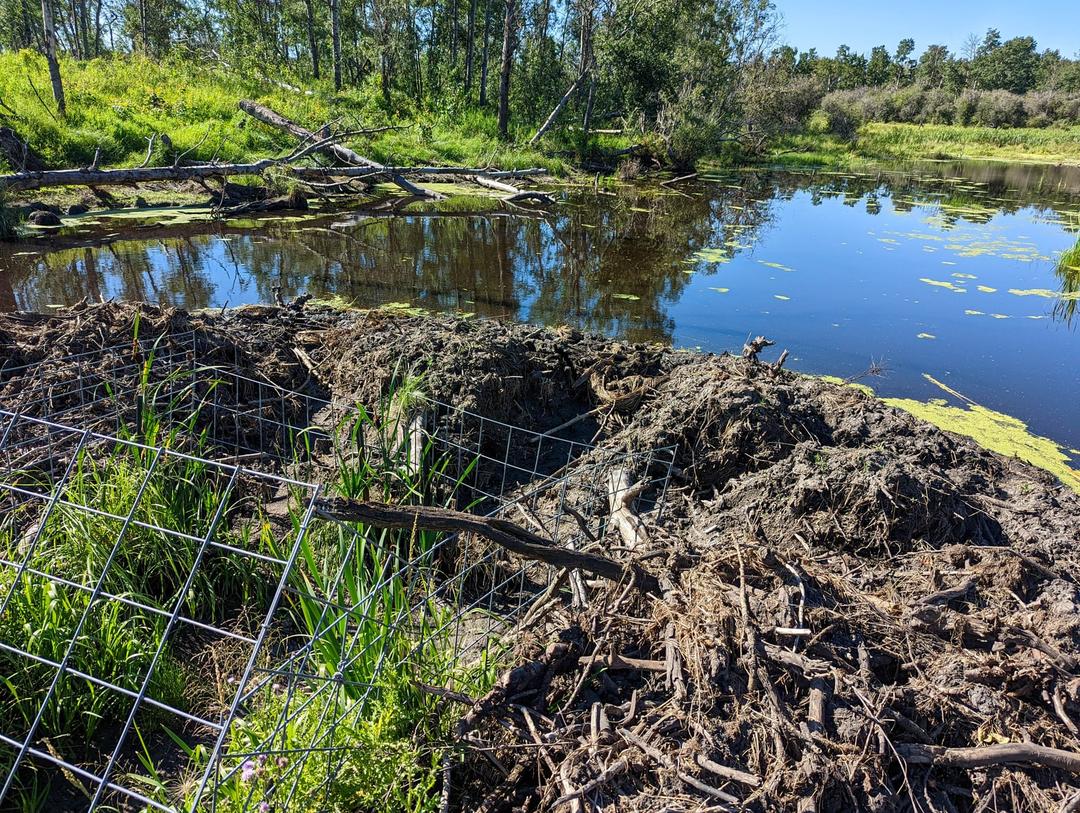
- Photos of the crossing, the outlet and the dam face
Clearing a dam without managing the level tends to bring the same call back, because the beavers are still there and the water still runs past the spot they want to hold. Our beaver dam flooding and culvert protection pages explain how we scope that work.
Do Saskatchewan's rules change what can be done?
Yes. Each province sets its own conditions for beaver work, and the authorization needed to breach, remove or otherwise alter a dam is not the same everywhere. In Saskatchewan, confirm the current provincial requirements with the ministry responsible for wildlife and water before any work on a dam or watercourse. Our BC dam removal rules page shows the kind of conditions involved in one province, but it does not set out Saskatchewan's requirements.
How do you tell if a beaver dam is still active?
Our method is a small test notch: about as wide as a boot and about 2 inches deep, just enough for the water to make noise as it runs through. Check it the next day. If the notch has been repaired overnight, the dam is active and the water level needs managing, not a one-time clearing.
The test works because beavers respond to the sound and feel of moving water at the dam. A fresh leak is something an active colony will patch quickly. A notch that is still running days later points to a dam that may no longer be maintained.
Breaching, removing or otherwise altering a dam can need provincial authorization, so check the rules for your location before you cut anything.
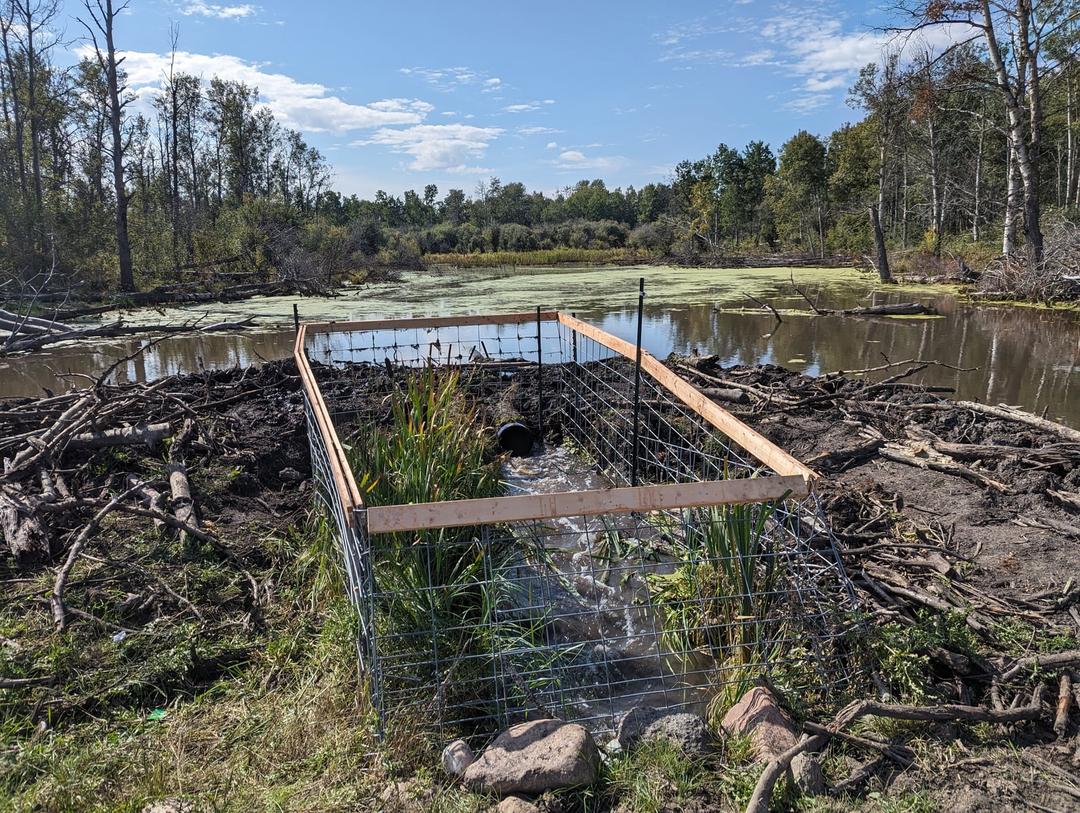
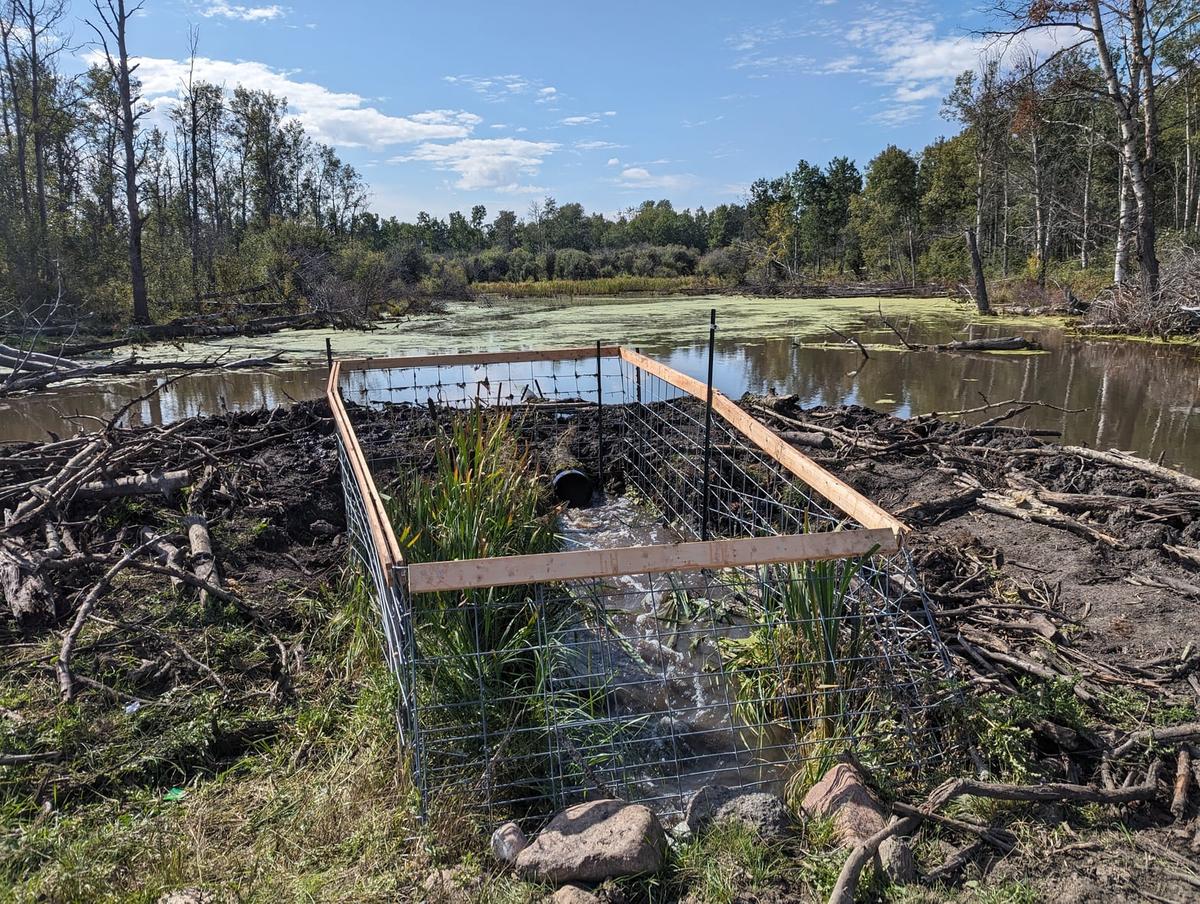
Where the water has to stay at a set level, a pond leveler or flow-control device keeps the outflow moving while the dam stays in place. Because water passes through a pipe rather than over or through the dam face, the beavers get no loud leak to fix.
Why do stock beaver deceivers struggle at culverts?
A beaver deceiver is a stock fence or screen set in front of a culvert to keep beavers from plugging it. Its limits are predictable: stock designs are often undersized for spring runoff, beavers and debris can block them, and they need regular clearing to keep working.
We do not install beaver deceivers. At culverts we use our own designs. Our combo devices pair an exclusion fence with a pond leveler running through it, sized to each crossing. For the culvert itself, we fit our own levelers using an installation method we developed, which is beaver-proof and guaranteed.
| Option | How it works | Where it falls short |
|---|---|---|
| Stock beaver deceiver | Fence or screen set in front of the culvert | Often undersized for spring runoff, blocked by beavers and debris, needs regular clearing |
| Pond leveler alone | Pipe through the dam holds the water level | Can be bypassed or blocked without exclusion at the dam face |
| Combo device (our design) | Exclusion fence with a leveler through it, sized to the crossing | Needs a site check to size it correctly for the crossing |
| Dam removal alone | Water drops quickly | Dams are often rebuilt, so the work repeats unless the level is managed |
How do you protect trees from beavers?
Enclose the trees you want to keep in sturdy wire mesh, and skip chicken wire. A study of urban riverine forests found that wire-mesh enclosures had an overall 80% effectiveness in deterring further beaver foraging, and that chicken wire performed worst because it girdles trees (University of Saskatchewan, 2019).
Plan for where the beavers go next. The same study found that when cottonwoods were protected in the managed reach, beavers shifted to Manitoba maple and green ash (University of Saskatchewan, 2019). Our tree protection page covers the options.
How does Humane Solutions work in Saskatchewan?
We cover Saskatchewan as part of our western Canadian practice, from our operating base near Revelstoke, sending specialists to the site rather than running a local crew. We are brought in for complex, high-profile and high-liability jobs that need a guaranteed professional result. Rural municipalities, agencies and landowners dealing with flooded road allowances, blocked culverts or dams in a drainage can read how we approach beaver management in Saskatchewan. When you get in touch, send the location, the photos and the date the flooding started, and say whether a culvert is involved.
Sources
- University of Saskatchewan, Busy Beavers in the Big City: An Analysis of Beaver Distribution, Foraging and Non-lethal Forage Management in Urban Riverine Forests (2019): https://harvest.usask.ca/items/80191e6b-1004-455a-a01d-04ee35099911
Common questions
Does Humane Solutions have a Saskatchewan office or crew?
No. We do not run a local office or crew in Saskatchewan. We send specialists to the site when a job needs them, and we are brought in for complex, high-profile and high-liability work that needs a guaranteed professional result.
Can I breach a beaver dam on my own land?
Check the provincial requirements first. Breaching, removing or otherwise altering a dam can need provincial authorization, and those conditions are set by the province, not by us. Confirm them before any work on a dam.
Who is responsible for beaver flooding on a rural road?
That depends on the road allowance, the drainage works and the land the dam sits on, so the rural municipality is the right first call. Ask the RM to confirm who manages the crossing before work starts.
What should I have ready when I contact a specialist about beaver flooding?
Have the location, photos of the dam and the crossing, the date the water started rising and whether a culvert or ditch is downstream. Those details let us scope the work and tell you what the site needs.